There is a game within the game in cricket. Not the one played on the field. The one played in press boxes, podcast studios, and editorial meetings in London, Sydney, and Nottingham. And the rules are simple: criticise BCCI loudly, then cash the cheque quietly.
It has become one of the most reliable cycles in world sport. A prominent English commentator writes a column about the IPL’s threat to Test cricket. An Australian analyst spends twenty minutes on a podcast explaining why BCCI’s governance is bad for the game. A respected publication runs a long read about India’s outsized influence on the ICC. The criticism is sharp, the language is strong, and the moral authority is worn openly.
Then India tours England. Or Australia. And something remarkable happens.
The same commentators start talking about the passion of Indian fans. The same publications run features on the brilliance of Indian batting. The same analysts are suddenly available for YouTube content about the series, building audiences they know will be overwhelmingly Indian. Tickets sell out. Stadiums fill. Advertising rates spike. And not one word is said about BCCI’s governance.
This is not a coincidence. It is a business model.
The Financial Reality Nobody Wants To Say Out Loud
Start with the numbers, because the numbers make the hypocrisy impossible to ignore.
BCCI generates over $2.2 billion annually — more than every other cricket board in the world combined. India represents approximately 90 percent of the revenues flowing into the ICC. Cricket Australia generates around $454 million a year. The ECB generates less. Both are significant operations. Both are financially dependent, in ways they rarely acknowledge publicly, on India’s continued engagement with the game.
When India tours England, stadiums that would otherwise be half-empty fill completely. When India plays Australia, television ratings reach levels that no other series generates. The Indian diaspora in both countries — and the streaming audiences back home — make India series the most commercially valuable events either board hosts.
So when English and Australian commentators reach for their laptops to write about BCCI’s excessive power, they are biting the hand that funds the sport they cover, the boards whose press accreditation they hold, and the YouTube audiences that pay their independent income.
The criticism happens in public. The negotiations happen in private. The money flows in one direction. The moral authority flows in the other. This is the model.
The Hundred: A Case Study In Selective Memory
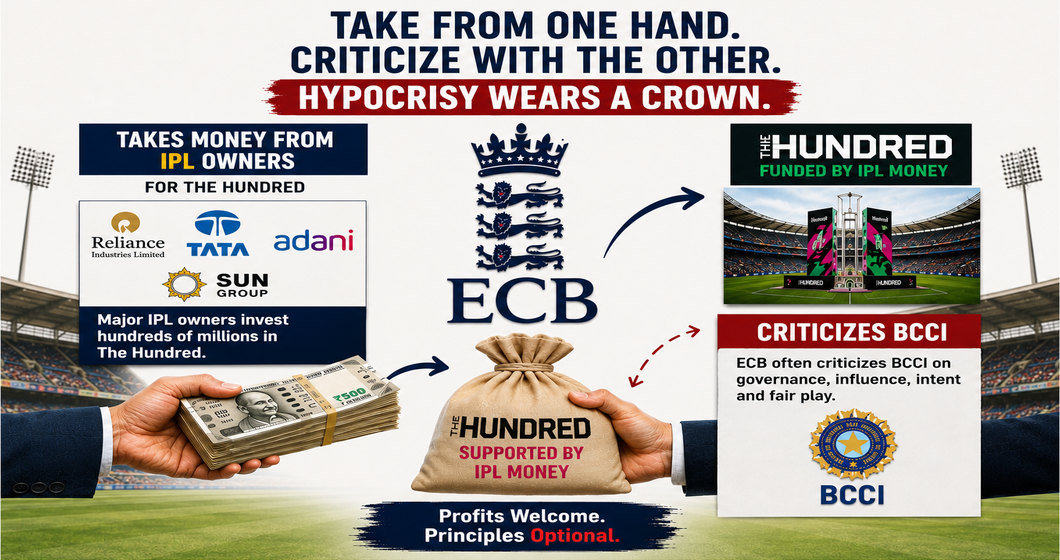
Nothing illustrates this dynamic more precisely than The Hundred — the ECB’s controversial 100-ball format competition launched, in part, to create a product attractive enough to sell to international investors. Which investors? The ECB has been explicit: IPL franchise owners.
The Ambani family, who own Mumbai Indians — one of the most valuable sports franchises in the world — were among the most sought-after potential investors. The ECB’s own leadership acknowledged that IPL owners moving into other national markets was something to be welcomed. English cricket, which through its media class has spent years positioning itself as the conscience of the game, was simultaneously asking the organisation it criticises to please buy a piece of its domestic competition.
The same publications that run op-eds about BCCI’s governance covered The Hundred’s investor search without connecting these two facts. The selective amnesia is not accidental. It is professional.
What The Criticism Gets Right — And What It Hides
To be precise: some of the criticism of BCCI is legitimate. The Mustafizur Rahman situation — where a Bangladeshi player bought at the IPL auction was released at BCCI’s behest, reportedly as political retaliation — is a serious governance failure that deserves scrutiny. BCCI’s influence over ICC scheduling, its ability to shape the global calendar around Indian preferences, its treatment of smaller cricket boards — these are real issues.
But legitimate criticism and selective criticism are different things. When a publication writes about BCCI’s governance while English cricket simultaneously courts IPL investment for The Hundred, the criticism loses its moral authority. It becomes positioning rather than principle.
You cannot do both. Or rather — you can. But Inside Left will notice. And we will say it plainly.
The YouTube Economy Of Outrage
The most acute version of this hypocrisy plays out not in print but on YouTube and podcasts. Channels built on English and Australian commentary traditions have discovered that BCCI-critical content generates strong engagement from audiences who feel BCCI’s power threatens the traditions they love. That content is produced consistently through the off-season.
Then India tours. And the algorithm changes. The same channels pivot to India series preview content, India player profiles, India fan engagement — because that is where the Indian audience is, and the Indian audience is the largest cricket audience on earth. The monetisation follows the eyeballs. The eyeballs follow India. And the criticism goes quiet until India goes home.
This is not journalism. It is arbitrage. Using one audience’s anxieties to build a platform, then monetising a different audience’s enthusiasm. The criticism is the product in the off-season. India is the product in the summer. BCCI is funding both, and nobody is saying so.
BCCI is not just funding Indian cricket. It is funding the platforms that criticise it. That is the story nobody wants to write.
The Verdict
The western cricket media’s relationship with BCCI is not a principled critique. It is a negotiation conducted in public, with moral language used as leverage. The criticism says: we are the custodians of cricket’s values. The financial reality says: we need your money, your audiences, and your investors.
BCCI knows this. That is precisely why it does not need to respond to the criticism. It simply waits for the next tour.
Inside Left does not take sides between BCCI and its critics. Both deserve scrutiny and we will apply it equally. But we will not pretend that criticism funded by the thing it criticises is independent. And we will not pretend that commentators who go quiet when India tours are motivated purely by principle.
Follow the money. In cricket, as in everything, it tells the real story.


Leave a Reply